
Am I an Employee or Independent Contractor Under California Law?
The distinction between employee and independent contractor is one of the most consequential classifications in California employment law. It determines whether you are entitled to minimum wage, overtime pay, meal and rest breaks, workers’ compensation coverage, unemployment insurance, and protection under anti-discrimination and retaliation laws. Independent contractors receive none of these protections.
California uses a strict legal test to make this determination, and it does not depend on what your contract says, whether you receive a 1099 instead of a W-2, or what your employer tells you. If you are performing work for a company in California, state law presumes you are an employee unless the company can prove otherwise.
Why Your Classification Matters
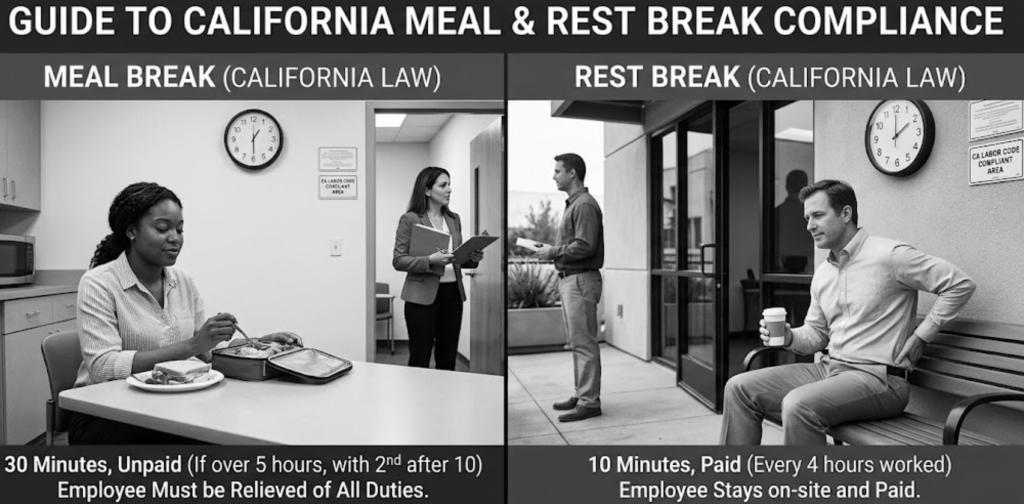
The rights you lose when classified as an independent contractor are substantial. Employees in California are entitled to the state minimum wage ($16.90 per hour in 2026), overtime pay for hours worked beyond eight in a day or 40 in a week, 30-minute meal breaks and 10-minute rest breaks, paid sick leave, workers’ compensation insurance for on-the-job injuries, unemployment benefits if laid off, and protection under the Fair Employment and Housing Act against discrimination and harassment.
Independent contractors receive none of these protections. They are responsible for their own taxes, insurance, and benefits. When a company misclassifies an employee as an independent contractor, the worker loses access to all of these rights, and the company avoids the costs of providing them. This is why misclassification is both common and illegal under California law.
The ABC Test: California’s Primary Classification Standard
Since January 1, 2020, California has used the ABC test as its primary method for determining worker classification. The test was first adopted by the California Supreme Court in Dynamex Operations West, Inc. v. Superior Court (2018) and then codified into law by Assembly Bill 5 (AB5).
Under the ABC test, every worker is presumed to be an employee. A company can only classify a worker as an independent contractor if it proves all three of the following conditions:
A – Free from control. The worker must be free from the control and direction of the hiring company in performing the work, both under the terms of the contract and in actual practice. If the company dictates when, where, and how you work, this factor is not satisfied.
B – Outside the usual business. The worker must perform work that is outside the usual course of the hiring company’s business. A bakery that hires a plumber to fix a leak is hiring outside its usual business. A bakery that hires cake decorators to work on its custom cakes is not. If the work you do is part of what the company sells or delivers, this factor likely fails.
C – Independent business. The worker must be customarily engaged in an independently established trade, occupation, or business of the same nature as the work being performed. This means the worker must have genuinely decided to go into business for themselves, not merely been told they are a contractor. Having a business license, marketing your own services, and working for multiple clients all support this factor.
If the company cannot prove all three conditions, the worker is an employee under California law. Failing even one prong means the ABC test is not satisfied.
How the ABC Test Works in Practice
Likely an Employee | Likely an Independent Contractor |
A delivery driver who drives for one company, follows the company’s route schedule, and wears the company’s uniform. | A licensed plumber hired by a restaurant to fix a broken pipe. The plumber runs their own business, sets their own schedule, and serves many clients. |
A graphic designer who works full-time for one marketing agency, uses the agency’s software, and attends required meetings. | A freelance graphic designer who operates their own studio, markets to multiple clients, sets their own rates, and uses their own tools. |
A janitor who cleans a building every weeknight on a schedule set by the building management company. | An electrician hired by an office to rewire a conference room. Electrical work is outside the office’s usual business. |
The Borello Test: When It Applies Instead
Not all workers are evaluated under the ABC test. AB5 includes exemptions for certain professions and industries. Workers in exempt categories are instead evaluated under the older Borello test, which uses a multi-factor analysis focused primarily on the degree of control the hiring company exercises over the worker.
The Borello test considers factors such as whether the company has the right to control the manner and means of the work, whether the worker can be discharged at will, whether the work is part of the company’s regular business, the skill required, who supplies the tools and equipment, the length of time the services are performed, the method of payment, and whether the parties believe they are creating an employer-employee relationship.
The Borello test is generally more favorable to companies than the ABC test, which is why many industries lobbied for exemption from AB5.
Who Is Exempt from the ABC Test?
AB5 and its subsequent amendments (including AB 2257) exempt several categories of workers from the ABC test. These workers are evaluated under the Borello test instead. Key exempt categories include:
Licensed professionals such as doctors, dentists, podiatrists, psychologists, veterinarians, lawyers, architects, engineers, private investigators, and accountants. Insurance agents and brokers. Securities broker-dealers and investment advisers. Direct sales salespersons who are not paid by the hour and have written independent contractor agreements. Real estate licensees governed by Business and Professions Code Section 10032. Workers providing services under a qualified business-to-business contract, provided certain conditions are met. Certain construction subcontractors with appropriate licenses. Workers in the commercial fishing industry. Workers providing licensed barber or cosmetology services and meeting specific requirements.
Being exempt from the ABC test does not automatically make someone an independent contractor. It simply means the classification question is decided under the Borello test, which still requires analysis of the working relationship.
Proposition 22 and App-Based Drivers
In November 2020, California voters passed Proposition 22, which created a separate classification framework for app-based transportation and delivery drivers, such as those working for Uber, Lyft, DoorDash, and Instacart. Prop 22 allows these companies to classify their drivers as independent contractors rather than employees, provided they meet certain conditions.
Under Prop 22, the network company cannot dictate specific work dates or times, require drivers to accept specific ride or delivery requests, restrict drivers from working for competing platforms, or restrict drivers from pursuing other lawful employment. In exchange, the companies must provide certain benefits including a healthcare subsidy, occupational accident insurance, and a minimum earnings guarantee.
Prop 22 applies only to app-based rideshare and delivery drivers. Workers in other industries, even those performing similar tasks, are not covered and remain subject to the ABC test or applicable exemptions.
Signs You May Be Misclassified
Misclassification is widespread in California. If you are classified as an independent contractor but any of the following apply to your situation, you may actually be an employee under the law:
The company controls when, where, or how you perform your work. You work exclusively or primarily for one company. The company provides your tools, equipment, or software. You perform work that is the same as what the company’s regular employees do. You were required to sign an independent contractor agreement as a condition of being hired. You do not market your services to other clients or operate your own business. You are paid hourly or on a set schedule rather than by project. The company can terminate you at will without regard to a contract.
The presence of any one of these factors does not automatically make you an employee, but several of them together strongly suggest misclassification.
What to Do If You Think You Are Misclassified
If you believe you have been misclassified as an independent contractor, you have several options. You can file a wage claim with the California Labor Commissioner’s Office to recover unpaid wages, overtime, and missed meal and rest break premiums. You can also file a claim with the Employment Development Department (EDD) for unemployment insurance and disability insurance benefits you were denied.
In some cases, you may be able to file a lawsuit against the company or bring a representative action under the Private Attorneys General Act (PAGA) on behalf of yourself and other misclassified workers. Many employment attorneys handle misclassification cases on a contingency basis.
California law imposes penalties on employers who willfully misclassify workers, including civil fines of $5,000 to $25,000 per violation. Misclassifying employers may also owe back taxes, unpaid wages, overtime, meal and rest break premiums, and penalties for inaccurate wage statements.
Frequently Asked Questions
Does my contract determine whether I am an employee or independent contractor?
No. California’s ABC test looks past the contract to the actual working relationship. A company cannot make you an independent contractor simply by having you sign an agreement that says so. The legal test is based on the reality of how the work is performed, not the label the parties use.
I receive a 1099 instead of a W-2. Does that make me an independent contractor?
Not necessarily. The type of tax form you receive reflects how the company has chosen to classify you, but it does not determine your legal status. Many workers who receive 1099s are actually employees under the ABC test and are entitled to all the protections that come with that status.
Can I be an independent contractor under federal law but an employee under California law?
Yes. California’s ABC test is stricter than the tests used under most federal laws, including the Fair Labor Standards Act and the IRS common-law test. It is possible to be classified as a contractor for federal tax purposes but still qualify as an employee under California’s labor and employment laws.
What if I prefer being an independent contractor?
Your preference does not change the legal analysis. The ABC test is designed to protect workers and prevent companies from shifting costs and risks onto individuals who are economically dependent on them. Even if you prefer the flexibility of contractor status, the law may still classify you as an employee based on the nature of the working relationship.
Understanding Your Classification
Worker misclassification costs California employees billions of dollars each year in lost wages, benefits, and protections. If you are unsure whether your classification is correct, or if you suspect your employer is misclassifying you to avoid its legal obligations, consulting with a California employment attorney can help you understand your rights and the potential value of your claim.