
Why Are Pedestrian Accidents So Serious?
Disclaimer: The information provided in this article is for general informational and educational purposes only. It is not intended to constitute legal advice and does not create an attorney-client relationship. Statutes of limitations and legal rights can vary based on specific facts and circumstances. You should not rely on this information without consulting a qualified attorney about your particular situation.
Common Causes of Pedestrian Accidents in San Diego
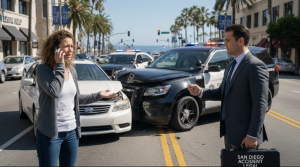
San Diego is a beautiful, walkable city, but certain factors consistently contribute to our high rate of pedestrian injuries:
- Distracted Driving: Motorists frequently check GPS or phones while navigating complex areas like the I-805/163 interchange or the busy streets of Downtown.
- Failure to Yield: Many drivers fail to see pedestrians in crosswalks, particularly when making right turns in high-traffic neighborhoods like Little Italy and Hillcrest.
- Technological Hazards: The “silent” nature of electric vehicles (EVs) can prevent pedestrians from hearing an approaching car. Additionally, the 2026 rise of high-speed e-bikes on shared paths has introduced new risks for those walking.
- Hotspots and Infrastructure: Accidents often cluster in “High-Injury Networks” like El Cajon Boulevard, University Avenue, and Pacific Highway, where high speeds meet heavy foot traffic.
Common Injuries in Pedestrian Collisions
Because of the extreme forces involved, pedestrian injuries are often catastrophic and require long-term medical care:
- Traumatic Brain Injuries (TBIs): Even low-speed impacts can cause the head to strike the asphalt, leading to permanent cognitive issues or intracranial bleeding.
- Lower Extremity and Orthopedic Fractures: Impact from a bumper often results in severe fractures to the pelvis, femur (thigh bone), and tibia/fibula (shin bones).
- Spinal Cord Damage: These injuries can lead to partial or total paralysis, with lifetime care costs often exceeding $3 million.
- Degloving and Severe Road Rash: Sliding across a roadway can tear away large sections of skin and tissue, necessitating multiple surgeries and skin grafts.
Proving Fault: Knowing Your Rights in California
There is a common myth that “the pedestrian is always right.” While California law is very protective of those on foot, liability is based on a “Duty of Care” shared by both parties.
- Right of Way (CVC § 21950): California law requires drivers to yield to pedestrians in all marked and unmarked crosswalks. An “unmarked” crosswalk exists at every intersection where sidewalks meet, even if there are no painted lines.
- Pure Comparative Negligence: In 2026, California still follows this favorable rule. Even if you were “jaywalking” or partially at fault for the accident, you can still recover damages. Your final settlement is simply reduced by your percentage of fault (e.g., if you are 20% at fault, you can still recover 80% of your total damages).
- The “Immediate Hazard” Rule: Pedestrians must still exercise care and cannot suddenly run into the path of a vehicle that is so close it cannot safely stop.
What to Do After a Pedestrian Accident
- Call 911: Ensure the San Diego Police (SDPD) or CHP creates a formal accident report to document the scene.
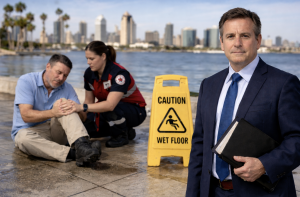
- Stay Still: If you feel back or neck pain, do not move. Wait for paramedics to prevent further spinal damage.
- Identify Witnesses: Busy areas like North Park or Downtown often have bystanders at bus stops or cafes. Collect their names and phone numbers.
- Preserve Evidence: Take photos of the car’s position, any skid marks, and the status of traffic signals.
- Seek Specialized Care: Severe trauma should be treated at a Level 1 Trauma Center, such as Scripps Mercy Hospital or UC San Diego Health in Hillcrest, which have the resources to handle life-threatening injuries.
Damages and Insurance Limits in 2026
As of January 1, 2025, California law (SB 1107) increased mandatory minimum insurance limits to $30,000 per person and $60,000 per accident. However, for a pedestrian with severe injuries, these minimums rarely cover the first few days of hospital bills.
At Tan Ngo Law Firm, we help victims pursue full compensation, which may include:
- Full Medical Coverage: Including future surgeries, home modifications, and rehabilitation.
- Lost Earning Capacity: Compensation for your inability to return to your previous job or career.
- Pain and Suffering: Non-economic damages for the physical pain and emotional trauma caused by the collision.